
What happens when you remove oil from Africa's mineral economy?
Africa's true hard rock mining powers emerge.
Africa's Top 5 Mineral Exporters (Excluding Oil & Gas):
🥇 South Africa - $52.2B Platinum, gold, diamonds, iron & steel, copper, nickel, rare earths
🥈 DR Congo - $48.7B Copper & cobalt king (60% of global cobalt, massive copper reserves)
🥉 Zambia - $16.7B Copper belt legacy
4️⃣ Egypt - $11.4B Copper, rare earths, iron & steel
5️⃣ Guinea - $8.9B Bauxite giant (3rd largest global reserves)
These Top 5 hard rock miners control 89% of non-oil mineral exports (vs. 76% when oil is included). Mining concentration is even stronger than energy.
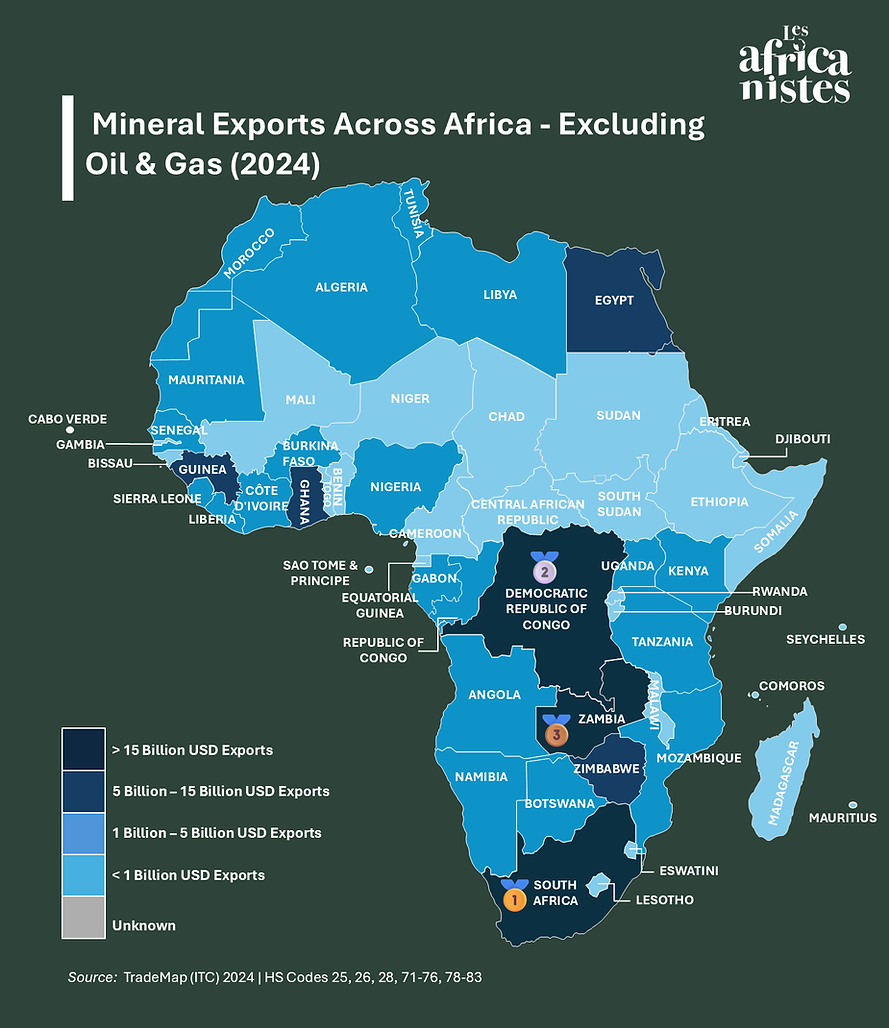
Data Table
Country | Mineral Exports Across Africa excluding Oil & Gas, in Billions USD (2024) |
South Africa | 52.18 |
DR Congo | 48.73 |
Zambia | 16.71 |
Egypt | 11.4 |
Guinea | 8.88 |
Ghana | 7.11 |
Zimbabwe | 5.4 |
Burkina Faso | 4.75 |
Namibia | 4.5 |
Morocco | 4.4 |
Tanzania | 4.27 |
Congo | 3.96 |
Uganda | 3.77 |
Côte d'Ivoire | 3.4 |
Botswana | 3.39 |
Mauritania | 3.03 |
Algeria | 2.42 |
Senegal | 2.26 |
Mozambique | 2.1 |
Angola | 1.72 |
Gabon | 1.57 |
Tunisia | 1.43 |
Liberia | 1.24 |
Sierra Leone | 1.24 |
Kenya | 1.04 |
Nigeria | 1.03 |
Libya | 1.02 |
Madagascar | 0.94 |
Mali | 0.74 |
Eritrea | 0.54 |
Cameroon | 0.43 |
Togo | 0.31 |
Rwanda | 0.27 |
Lesotho | 0.24 |
Mauritius | 0.14 |
Seychelles | 0.09 |
Sudan | 0.07 |
Benin | 0.06 |
Burundi | 0.06 |
Central African Republic | 0.06 |
Ethiopia | 0.05 |
Djibouti | 0.05 |
South Sudan | 0.03 |
Somalia | 0.02 |
Equatorial Guinea | 0.01 |
Niger | 0.01 |
Eswatini | 0.01 |
Malawi | 0.01 |
Chad | 0 |
Gambia | 0 |
Sao Tome and Principe | 0 |
Comoros | 0 |
Guinea-Bissau | 0 |
Data Sources:
Source: TradeMap ITC Database (2024)
Metric: Export values in USD billions
Coverage: All 54 African countries
HS Codes EXCLUDED: HS 27 (Mineral Fuels - Oil, Gas, Coal)
HS Codes INCLUDED:
HS 71: Precious Stones & Metals (Gold, Diamonds, Platinum)
HS 26: Ores, Slag & Ash (Bauxite, Iron Ore, Manganese)
HS 74: Copper & Articles
HS 72: Iron & Steel
HS 76: Aluminum & Articles
HS 28: Inorganic Chemicals & Rare Earths
HS 81: Other Base Metals (including Cobalt)
HS 75: Nickel & Articles
HS 79: Zinc & Articles
HS 78: Lead & Articles
HS 80: Tin & Articles
HS 25: Salt, Sulfur, Stone, Cement
HS 73, 82, 83: Iron/Steel Articles, Tools, Misc. Metal Articles
What's included: All solid mineral and metal exports excluding fossil fuels. Focuses on hard rock mining: precious metals, industrial metals, battery metals, rare earths, and steel.
How it's calculated: Total mineral exports (Map 1) minus HS Code 27 (Mineral Fuels) for each country.
What's excluded: Oil, gas, coal, processed/manufactured goods, re-exports, informal mining.
Important Limitations of Data Used in Our Analysis:
Export Values vs. Mining Infrastructure
High exports don't always mean strong institutions
DRC has huge exports but weak governance/infrastructure
South Africa has lower volume but better processing/value-add
Cobalt Reporting Issues
DRC cobalt often smuggled or misreported
Actual figures may be higher than official data
Artisanal mining sector largely informal
Different Mining Models
Doesn't distinguish between raw ore exports vs. processed metals
Guinea exports raw bauxite; South Africa exports refined platinum
Value-add not reflected in raw export values
Geographic Concentration
89% concentration in Top 5 shows extreme inequality
Central/Southern Africa dominate (mining belts)
West/North Africa (excluding Morocco) largely oil-dependent
Economic Diversification Not Shown
Low mining exports doesn't mean poor economy
Rwanda, Mauritius have strong economies, minimal mining
Agriculture, services, manufacturing not captured
Temporal Factors
Zambia/Tanzania affected by 2024 droughts (hydropower issues)
New mines coming online may shift 2025-2026 rankings
Battery metals demand surging (cobalt, nickel, lithium).